
When Tuesday Gets Wonky: Small Business Stability Resources
Practical tools to help you protect time, revenue, and trust when an ordinary business day gets interrupted.
When Tuesday Gets Wonky

A simple resource page for protecting time, revenue, and trust when an ordinary business day gets interrupted.
Thank you for joining me at the Chamber Breakfast. This page includes the tools and follow-up resources from the presentation so you can take the next step inside your own business.
Most business disruptions do not start as major disasters. They usually begin with ordinary problems: the internet drops, a key person is unavailable, a payment system fails, a customer is waiting, or no one knows where the backup process is written down.
That is when a normal Tuesday can become costly.
The goal is not to make business owners emergency management experts. The goal is to help you see where lost time, lost revenue, and lost trust can show up, and give you a simple way to prepare before it happens.
Start with the C.R.A.P. Card below. It helps you think through four practical questions every business should be able to answer: who covers the work, what happens first, where key information lives, and what matters most in the first hour.
What We Covered
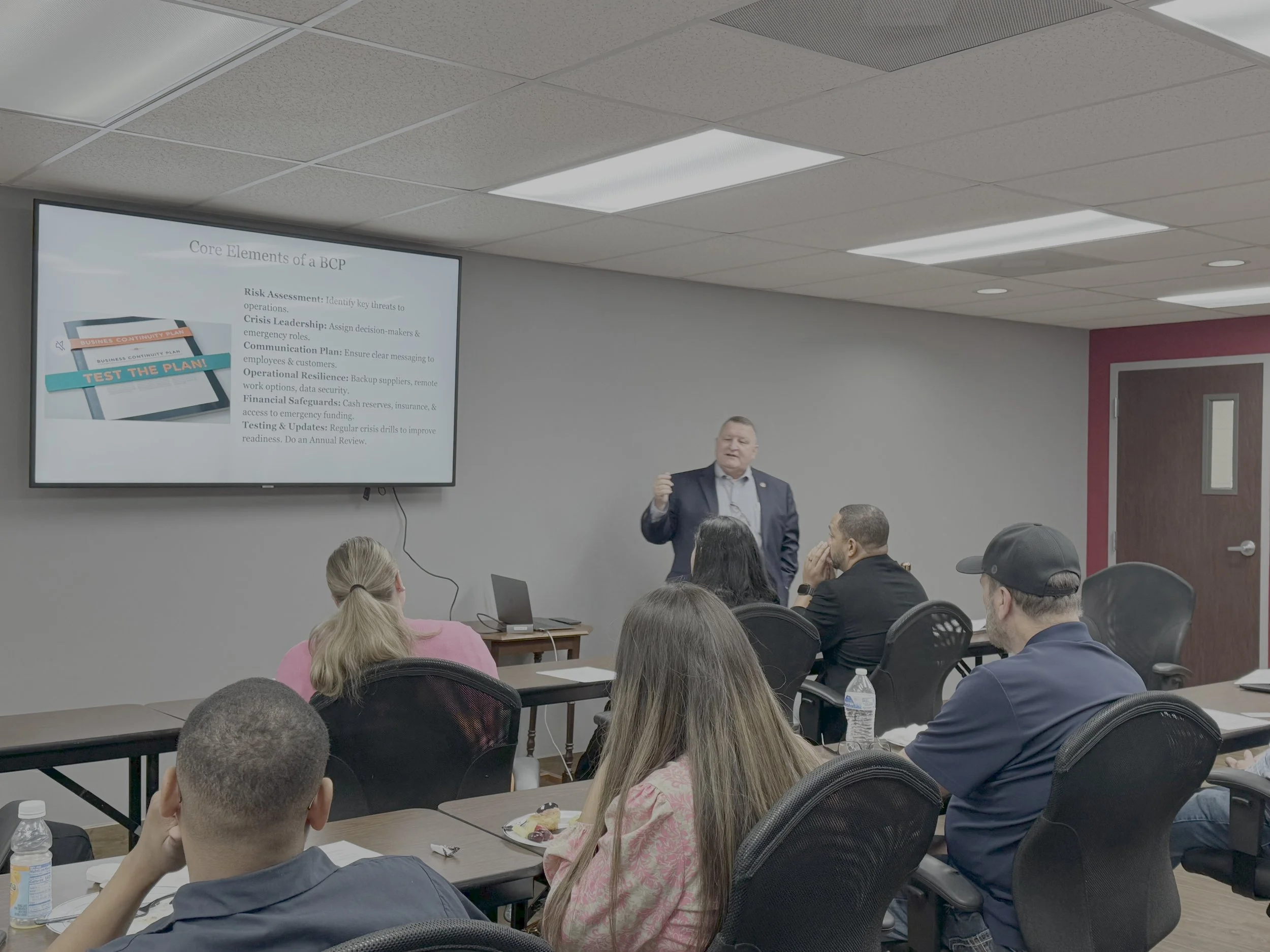
At the Chamber Breakfast, we looked at how everyday disruptions can quickly create lost time, lost revenue, and lost trust if the business has not already answered a few simple questions.
The focus was not on big disasters. It was on the normal problems that interrupt a regular workday: a key person is unavailable, the internet goes down, a customer is waiting, a payment process stops, or the team is unsure what to do first.
We centered the conversation around four practical readiness questions:
Coverage: Who keeps the work moving if the right person is unavailable?
Response: What should the team do first when something interrupts the day?
Access: Where are the key contacts, logins, forms, instructions, and backup steps?
Priority: What matters most in the first hour to protect customers, revenue, and trust?
The C.R.A.P. Card below gives you a simple way to start answering those questions with your team.
One Action You Can Take This Week

Before you build a plan, start with one simple question:
If you were unavailable for two hours during a normal business day, what would stop, slow down, or get confusing first?
Ask that question with your team this week. You do not need a long meeting or a formal planning session. Take ten minutes and write down the first few answers that come up.
Look for practical gaps like:
Who would cover the work?
Would someone know what to handle, what to delay, and who needs to be updated?
Where would key information be found?
Would the team know where to find contacts, logins, forms, vendor information, schedules, or backup steps?
What should happen first?
Would people know the first move to protect customers, revenue, and trust?
The goal is not to fix everything at once. The goal is to find the first weak spot before a normal workday turns into lost time, lost revenue, or a customer-confidence problem.
Use the C.R.A.P. Card below to turn that conversation into a simple first-hour readiness check.
Download the C.R.A.P. Card
A simple first-step tool for protecting time, revenue, and trust when the workday gets interrupted
The C.R.A.P. Card is a one-page tool you can use with your team to identify where an ordinary disruption could create confusion, delays, or lost business.
It focuses on four practical questions:
Coverage:
Who keeps the work moving if the right person is unavailable?
Response:
What should the team do first when something interrupts the day?
Access:
Where are the key contacts, logins, forms, vendor numbers, backup steps, and instructions?
Priority:
What matters most in the first hour to protect customers, revenue, and trust?
You do not need to complete a full business continuity plan to start making your business more stable. Begin with the card, answer what you can, and use the blanks to identify the areas that need attention.
Use this with your team during a short staff meeting, owner check-in, or weekly planning conversation
Want Help Applying This to Your Business?

A short conversation can help you find the first place to start
You do not need to fix everything at once. Most businesses make the most progress by starting with one practical question:
Where could we lose time, revenue, or customer trust if something interrupted the workday?
A Stability Check-In is a short, practical conversation to help you think through that question. We can look at your business, talk through one or two common weak spots, and identify a simple next step that makes sense for your operation.
This is not about making your business complicated. It is about helping you protect the work you have already built.
No pressure. No complicated planning session. Just a practical conversation about where your business may be more vulnerable than it needs to be.
A Resource Worth Reviewing: R4R


Preparedness resources today, and a potential $5,000 recovery grant opportunity if a qualifying disaster affects your area.
The U.S. Chamber Foundation’s Readiness for Resiliency program, often called R4R, helps small businesses take practical steps before a disaster and recover more quickly afterward.
One reason this resource is worth knowing about is the potential for a $5,000 recovery grant if a qualifying disaster affects your area (zip code). According to the U.S. Chamber Foundation, businesses must register before a disaster, complete the required preparedness checklist step, and, if selected after a qualifying disaster, document at least $5,000 in disaster-related losses.*
* Eligibility, funding, disaster qualification, documentation, and selection are controlled by the R4R program and may change.
The readiness step matters even if you never apply for a grant. The preparedness checklist encourages small business owners to think through practical questions: how vulnerable the business is, how employees and customers would be protected before, during, and after an emergency, and how preparedness becomes part of everyday workplace culture. It also points owners toward planning basics such as emergency contacts, employee communication, continuity procedures, training, supplies, and practicing the plan.
If you want help understanding the R4R readiness steps, I offer a free 15-minute Stability Check-In to help you decide where to start.
If you want hands-on help completing the assessment, identifying gaps, or turning the checklist into practical next steps, we can discuss a paid readiness support option.
Grant eligibility and approval are not controlled by Porters of Porter. My role is to help you understand the readiness steps, identify practical gaps, and strengthen your business before something happens.
Hurricane Season Business Stability Checklist
A practical pre-season check for protecting time, revenue, and customer trust before the next storm threat.

Hurricane readiness is not just about supplies and weather updates. For a business, the bigger question is whether you can protect your people, reach key information, communicate clearly, and keep essential work moving if a storm, outage, vendor delay, or staffing gap interrupts the day.
I created this checklist as a simple starting point for local business owners and leaders. It helps you review six practical areas before the season gets active:
Insurance coverage. Critical vendors. Key systems. Records and cash flow. Business relationships. First-hour decisions.
Use it with your team, your manager, or your key advisors. You do not need to fix everything at once. Start with the areas most likely to cost you time, revenue, or customer trust if the workday gets interrupted.
A free business stability resource from Porters of Porter
Building a Practical Local Stability Network


Business owners should not have to guess who to call when the same problem keeps coming back.
Sometimes the right next step is financial clarity. Sometimes it is IT, insurance, HR, legal, restoration, accounting, healthcare operations, or another specialized partner.
My role is helping owners identify what kind of problem they actually have, what should happen first, and who belongs at the table.
If you are a banker, CPA, IT provider, insurance advisor, HR consultant, restoration company, attorney, healthcare advisor, or another business support professional, I would like to know you.
This is not about trading leads. It is about helping owners get the right help at the right time.